











What Maria did to get
thousands of more dollars
for her total-loss vehicle
than the valuation amount
in the CCC market valuation report.
Maria’s total-loss claim
was a first-party claim.
She was dealing with
her own automobile insurance company.
Maria filed her first-party total-loss claim
soon after her 2018, 5‑door,
Grand Touring Mazda3 was totaled.
Maria received a “market valuation report”
from her insurance company.
CCC Information Services
a.k.a. CCC Intelligent Solutions
had prepared the report.
Maria was distressed at how low
the report’s valuation was.
The CCC market valuation report
valued Maria’s totaled vehicle
at $17,467 (sales tax not included).
The valuation was less
than the balance of her car loan.
If there was nothing that she could do
and she had to accept this valuation, then
she would have to keep making payments
on an automobile that no longer existed.
I told Maria that,
when my automobile was totaled,
I did not accept
the insurance company’s valuation.
I told her what I did to challenge it.
I told Maria that CCC
had generated a market valuation report
for my total‑loss vehicle for Travelers.
The CCC market valuation report
had lots of omissions, errors,
and other problems.
A careful reading
of the CCC market valuation report
led me to suspect
that Travelers and CCC
had conspired to cheat me
out of a fair valuation
of my total-loss vehicle.
I told Maria that, to start with,
she might want to check
the CCC market valuation report
for her totaled vehicle
for omissions and errors
in the description of her total‑loss vehicle.
Thus alerted, Maria examined
the CCC market valuation report
on her car.
Maria found that
the CCC market valuation report
left out her car’s
communications system,
intelligent cruise‑control system,
lane‑departure warning system,
lane keep assist, metallic paint,
wheel‑lock anti‑theft tire‑protection system,
heated steering wheel, automatic braking,
Homelink universal garage door opener,
and auto‑dim rearview mirror.
Maria sent the claims agent an email
in which she notified the claims agent
of these omissions.
The claims agent had CCC
re‑run the valuation
with the omitted options included.
CCC came back
with a revised market valuation report.
The revised CCC market valuation report
added a measly $450
to the value
of Maria’s total‑loss vehicle.
The “revised” CCC market valuation report
valued her total‑loss vehicle
at $17,917, a valuation increase of only 3%.
Maria then asked me to look
at the CCC market valuation report
with her.
Before we did that, I suggested
that we find out what a fair valuation
of her total‑loss vehicle would be.
Like most other state insurance
commissioners, the New Jersey
Commissioner of Banking and Insurance
allowed insurance companies
to use NADA Guides retail values
to value total‑loss vehicles.
(NADA Guides is now J.D. Power.)
To get an exact NADA Guides valuation,
we needed detailed information
on her Mazda3.
To make our task easier,
we wanted to get a digital copy
of her total‑loss vehicle’s
Monroney Label window sticker.
To get a digital copy,
Maria went to the website
www.monroneylabels.com,
entered the Mazda3’s VIN number,
paid the $7.99 fee (now $9.99),
and had a PDF of the Monroney Label
instantly emailed to herself.
With the Monroney‑Label in hand,
to get a fair retail valuation
of Maria’s Mazda3,
we went to www.nadaguides.com.
At www.nadaguides.com,
we stepped through
the vehicle‑selection dialog:
-
manufacturer,
-
model year,
-
model,
-
trim level,
-
ZIP Code,
-
mileage,
-
and major options.
CCC’s initial valuation was $17,467.
CCC’s revised valuation was $17,917.
NADA Guides gave us
a retail price with options of $21,625
(sales tax not included).
$21,625 - $17,467 = $4,158.
$21,625 - $17,917 = $3,708.
The NADA Guides value was $4,158 more
than CCC’s initial valuation.
It was $3,708 more
than CCC’s revised valuation.
“Why?” we wondered.
We examined
the CCC market valuation report
for Maria’s totaled vehicle.
We focused on the methodology
that CCC used to value her vehicle.
When we realized
how CCC had concocted
such a low valuation,
our faces contorted
like we had just sucked lemons.
Our heads swiveled to face one another.
Our eyeballs rolled back into our heads!
Based on what we discovered,
Maria wrote a letter
to her insurance company.
She wrote a covering email.
She attached the letter to the email.
She attached to the email a PDF
of the NADA Guides valuation report
that we generated.
She attached to the email a PDF
of the Monroney Label window sticker
that she got from monroneylabels.com.
Maria sent the email and attachments
to the claims agent.
Here’s what the letter
(slightly redacted and clarified)
that Maria sent to the claims agent said:
Dear REDACTED,
Thank you ever so much for your gracious help
with my total‑loss claim.
I especially appreciate your offering
to work with me to come up with
a loss‑vehicle valuation that is fairer
than the one that CCC submitted to you.
After the experience that a close friend of mine
had with CCC, I cannot help but be suspicious
of any valuation that CCC provides.
A drunk driver passed out, crashed into
and destroyed a parked vehicle
that belonged to my friend.
Travelers was the insurer
for the drunk driver’s vehicle.
Travelers had CCC perform the valuation
of my friend’s total‑loss vehicle.
My friend found CCC’s valuation
to be blatantly fraudulent.
He exercised his right of recourse.
Travelers refused give my friend
a fair valuation of his total-loss vehicle.
My friend sued.
He won an award that was several times
the amount of CCC’s initial valuation
of his total‑loss vehicle.
Similarly, CCC appears to be
playing fast and loose
with the valuation of my total‑loss vehicle.
None of the three “comps”
that CCC used to value my total-loss vehicle
satisfy the legal definition
of substantially similar vehicles.
Also, the nine other “comps”
that CCC lists on its valuation document
do not satisfy the legal definition
of substantially similar vehicles.
According to the New Jersey
administrative code that governs
automobile physical damage claims:
“ ‘Substantially similar vehicle’ means
a vehicle of the same make, model, year
and condition, including all major options
of the insured vehicle. Mileage
must not exceed that of the insured vehicle
by more than 4,000 miles. Mileage differences
of more than 4,000 miles may,
at the option of the insured,
be exchanged for the presence or absence
of options or a cash adjustment.”
My total‑loss vehicle had 30,440 miles
on the odometer.
CCC’s three “comp” vehicles
have mileages of 4,020 miles; 5,186 miles; and 7,706 miles—
for an average mileage of 5,637 miles.
30,440 miles minus 5,637 miles
equals 24,803 miles.
A difference of 24,803 miles is
more than six times the legal limit
for a substantially similar vehicle.
Hence, CCC’s valuation
appears to be intentionally inconsistent
with the substantially similar requirements
of New Jersey state law.
In its bogus valuation, CCC
appears to use the mileage differences
to reduce the Base Vehicle Value in two ways:
-
Under Vehicle Allowances,
CCC deducts $892
with the questionable claim
that my total‑loss vehicle had more miles
than the average vehicle. -
From the average value
of its three “comp” vehicles,
CCC deducts $3,186.
CCC does not make it possible for claimants
to mathematically analyze their valuations.
They hide their opaque manipulations
under the explanation:
“Finally, the Base Vehicle Value is
the weighted average of the adjusted values
of the comparable vehicles
based on the following factors:
-
Source of the data (such as inspected versus advertised)
-
Similarity
(such as equipment, mileage, and year) -
Proximity to the loss vehicle’s
primary garage location -
Recency of information”
Accordingly, I cannot figure out whether,
by using their non‑comp “comps,”
CCC is attempting to penalize me $3,186
or [($3,186 + $892) = $4,087].
Going by the $3,186 average deduction
for the “comps,” it appears
that CCC is attempting to penalize me
for the 24,803 average difference in mileages
at the rate of $0.1285 per mile.
Since the maximum difference in mileages
that the law allows without the consent
of the claimant is 4,000 miles;
the maximum penalty for mileage difference
appears to be $514.
Hence, to bring CCC’s valuations
into closer compliance with the law
would mean adding back
to the average comp value
at least $3,186 - $514 = $2,672.
CCC lists nine other “comp” vehicles
in their bogus valuation document.
Those vehicles have odometer readings of:
3,359 miles; 3,019 miles; 4,237 miles;
6,965 miles; 5,035 miles; 7,370 miles;
5,439 miles; 2,254 miles; and 4,031 miles.
Hence, the difference in mileage
between every one of these vehicles
and the total‑loss vehicle’s mileage
of 30,440 miles is at least five times
the legal limit of a difference of 4,000 miles
for substantially similar vehicles.
Accordingly, none of these vehicles
even come close to legally qualifying
as a substantially similar vehicle.
To arrive at a fair valuation,
you asked me to find comparable vehicles
within a 25 mile radius of my ZIP Code, 07722.
To be comparable,
otherwise substantially similar vehicles
would have to have odometer readings
between 26,440 miles and 34,440 miles.
However, just as CCC
was unable to find any vehicles
that meet these requirements
of the New Jersey Administrative Code,
I have been unable to find any such vehicles.
As I understand the sections
of the New Jersey Administrative Code
that govern auto physical damage claims,
the New Jersey Department of Banking
And Insurance allows insurers
to use valuation methods other than
relying on vendors such as CCC.
I would think that using an alternative method
would be especially advisable
when none
of a valuation services vendor’s comp vehicles qualify as substantially similar
to a claimant’s total-loss vehicle.
One alternative methodology
that NJ Administrative Code 11:3-10.4
Adjustment of total losses (a)(1.)(iii) provides
is retail values from these manuals:
“Manuals approved for use
on or after January 1, 1976 are
“Automobile Red Book” and
“Older Car/Truck Red Book” published by
Maclean Hunter Market Reports, Inc.
and the “N.A.D.A. Official Used Car Guide”
and “N.A.D.A. Official Older Car Guide”
published by the National Automobile Dealers
Used Car Guide Company.”
As I’m sure you know,
the New Jersey Administrative Code also says,
“If the insurer elects to make a cash settlement,
it must bear in mind at all times
that the insured’s position
is that of a retail consumer
and the settlement value arrived at
must be reasonable and fair for a person
in that position.”
That is, the required settlement value is
the retail value necessary to replace
the total‑loss vehicle.
I obtained a retail value for the total‑loss vehicle
from the online version of one of these,
the N.A.D.A., at
https://www.nadaguides.com/Cars/2018/Mazda/Mazda3/Wagon-5D-Grand-Touring/Values .
The N.A.D.A. retail value is $21,625.
A copy of the valuation report accompanies
this letter.
As is not the case with CCC’s
deeply flawed valuation, I would accept
the N.A.D.A. retail value as a fair, legal
and legitimate actual cash value.
This alternative, approved valuation
methodology leaves us with:
$21,625 Actual cash value
+ 1,433 Sales tax @ 6.625%
= $23,058 Cash value plus sales tax
$23,058 Cash value plus sales tax
- 500 Deductible
= $22,558 Claim settlement
Given the absence of substantially similar
vehicles that have mileages within 4,000 miles
of the mileage of the total‑loss vehicle
and that are for sale within twenty‑five miles
of the total‑loss vehicle’s ZIP Code
of garagement, I hope that you
and your colleagues will agree
that the N.A.D.A. retail value
is a value that is fair to all.
Thank you again for all of your gracious
assistance.
With best personal regards,
Maria
After Maria sent the letter,
we were thinking,
“Maybe they’ll come back
with an offer to meet her half way.”
Maria was thinking,
“If they offer to meet me half way,
I’ll probably accept that offer.”
Less than a week after Maria emailed
the letter to her insurance company,
she got an email back from them.
Here’s what the insurance company’s
response to Maria’s letter said:
Good Afternoon Maria,
I reviewed the additional paperwork you
supplied and in efforts to resolve the claim,
I can use the NADA Guides value you
supplied.
I can offer you a settlement as follows:
$21,625.00 NADA Guides value
+ 1,432.66 tax
--------------------
= 23,057.66
- 500.00 deductible
--------------------
= $22,557.66
Please confirm you agree/accept
and I will reach out to your lien holder
to obtain pay off information.
I look forward to hearing from you.
Thank you and have a great day!
REDACTED
When Maria and I read the email,
we both yelled the same reaction:
“ W h o a ! ! ! ”
The insurance company
didn’t meet Maria half way.
They met her all the way!
High fives! Yes! Maria rules!
Maria! Maria! Maria!
What did Maria achieve?
When Maria pointed out
the omissions and errors
in the CCC market valuation report’s
description of her total‑loss vehicle,
she got a $450 or 3% increase
in CCC’s pre‑sales‑tax
valuation of her vehicle.
When Maria pointed out
the flaws
in how CCC valued her total‑loss vehicle
and proposed using the NADA Guides valuation instead,
she got an additional $3,708
or 21% additional dollars
in the insurance company’s valuation
of her total‑loss vehicle.
In sum, sales tax included,
Maria increased the valuation
of her total‑loss vehicle
from $18,624 to $23,058.
That’s $4,434 additional dollars!
That’s 24% additional dollars!
That’s $4,434 additional dollars
just for writing one email
and then one letter.
The hours of work
that Maria did
to get a fair valuation
paid off handsomely.
Total-loss claimants
who live in New Jersey
have a right of recourse.
Should Maria have exercised
her right of recourse?
Perhaps.
Perhaps not.
Maria’s claim was a first-party claim.
She was dealing with
her own automobile insurance company.
Maria chose not to exercise
her right of recourse
because she had had
her automobile insurance
and her homeowner’s insurance
with the same insurance company
for decades.
Maria reasoned that,
if she pressed her insurance company
to the max
on the valuation
of her total-loss vehicle,
then, at some future date,
her insurance company
might be less than fully cooperative
on a bigger, more complicated claim
under her homeowner’s coverage.
If Maria had been able to find
a substantially similar vehicle
for sale at an automobile dealership
and she had exercised her right of recourse,
Maria likely could have gotten
even more money.
But, often in life, we have to balance
what we want to gain in a transaction
against what we want to preserve
in a relationship.
Maria struck the balance
that she believed
was best for her.
Even if your total-loss claim
is a first-party claim
in which you are dealing with
your own automobile insurance company,
your situation may be different.
Your reasoning may be different.
You may be able to find
a substantially similar vehicle
for sale at an automobile dealership
that is for sale at a higher price
than your total-loss vehicle’s
J.D. Power Buy from Dealer price.
You may want to get
all the money you can.
You may want to exercise
your right of recourse.
If your total-loss claim is a third-party claim
in which you are dealing with
the automobile insurance company
of an at-fault driver
whose negligent act
caused the destruction of your vehicle
and you have a right of recourse,
then you have no reason not to exercise
your right of recourse
if doing so is likely to get you
more money.
Whether you agree
with Maria’s decision or not,
Maria broke trail.
Maria helped pioneer
wasyourcartotaledorstolen.com.
Through her example,
Maria is showing you
and millions of other Americans
how you and they
can get fair valuations
of your total-loss vehicles
in first-party total-loss claims.
If you achieve more than Maria achieved,
you will do so, in part,
because Maria did what she did
and beause she gave me permission
to share what she did
with you.
Thank you, Maria!
You are an inspiration to us all!
What_Maria_did_to_get_her_more_moneyChapter
What I did to get
thousands of more dollars
for my total-loss vehicle
than the valuation amount
in the CCC market valuation report.
A little after 6:00 AM one Sunday morning,
while I was home asleep,
a young woman,
who had been out drinking all night,
while she was driving
on the street where I live,
passed out at the wheel.
She crashed the 2008 Toyota
that she was driving
into my vintage 1986 Jeep Cherokee.
My parked Cherokee kept her car
from crashing
into a thirty‑foot‑tall sycamore tree—
impact with which might have killed her.
Other than drunk,
the young woman was okay.
Her Toyota was totaled.
My Cherokee was totaled.
The young woman’s negligent act
(driving while drunk, passing out,
and crashing into my vehicle)
caused the destruction of my vehicle.
Travelers was the insurer of her vehicle.
Hence, my total-loss claim
was a third-party claim
against the negligent at-fault driver
and Travelers.
A few days after the crash,
a Travelers Claim Appraiser
inspected my vehicle.
Based on his inspection,
at Travelers’s request,
CCC Information Services
a.k.a. CCC Intelligent Solutions
prepared a CCC market valuation report
for my vehicle.
The Claim Appraiser emailed me
a copy of that document.
The CCC market valuation report
valued my total‑loss vehicle at $1,644.01
(which included the New York City
vehicular sales tax at 8.87%).
I was surprised at how low
the valuation was.
Why was it so low?
When I looked at the details
of the CCC market valuation report
for my total-loss vehicle,
I discovered that the description
of my vehicle contained lots
of omissions, errors, and misrepresentations.
If I let Travelers and CCC get away
with these omissions and errors,
I would not get a fair valuation
of my total‑loss vehicle.
Accordingly, I wrote the following letter
(which I have redacted slightly)
to the Travelers Claim Handler
who was handling my claim.
Re: Claim H3H9516
CCC Market Valuation Report
Dear Ms. REDACTED,
Early Sunday morning, August 21,
your insured party Jacklyn REDACTED who,
according to the police report, was driving drunk
(aggravated driving while intoxicated),
crashed into and totaled my Jeep Cherokee
that was parked on Bleecker Street
near my residence in New York, NY.
At the request
of Travelers Claim Appraiser Vladimir Titensky,
CCC prepared a Market Valuation Report
for my Jeep Cherokee.
Mr. Titensky provided me
with a copy of that report.
I was appalled, disappointed and mystified
to discover that the Market Valuation Report
that CCC prepared is filled
with inaccurate statements,
sloppy representations and misrepresentations
that— were I to rely on them—
could prove to be fraudulent misrepresentations.
In the table on the following pages,
I itemize page by page
the report’s obvious inaccuracies, sloppiness,
and potentially fraudulent misrepresentations.
The question I have for you is this:
Does Travelers intend to pursue settlement
of my claim on the basis of CCC’s inaccurate,
sloppy and potentially fraudulent report?
Or will Travelers undertake an accurate,
careful and honest valuation of my vehicle
that Ms. REDACTED is charged
with the crime—
among others—
of destroying?
More generally, I cannot help but wonder:
For its valuation reports, will Travelers continue
to do business with and rely upon a company—
CCC— that produces inaccurate, sloppy
and fraudulent reports?
CCC’s Representations
Problems with CCC’s
Representations
“Loss vehicle has 2% greater than average mileage of 183,900.”
CCC does not bother to mention
what it is that they average
so they can calculate
a greater‑than or less‑than
percentage of average mileage.
One might assume that the relevant average
would be the average mileage of vehicles
of the same age and category type.
According to the U.S. Department of Energy’s
report of Average Annual VMT
[vehicle miles traveled] per Vehicle
by Vehicle Type available at http: //www.afdc.energy.gov/uploads/data/data_source/10308/10308_fuel_use_veh_type.xlsx,
light‑duty vehicles are driven
an average of 11,346 miles per year.
Hence, the average mileage
of a 30‑year old light‑duty vehicle
would be roughly 340,380 miles.
Hence, the vehicle that CCC purports to value
has not 2% greater than average mileage
of 183,900 but 45% less than average mileage
of 340,380.
BASE VEHICLE VALUE
This is derived from comparable vehicle(s)
available or recently available
in the marketplace at the time of valuation,
per our valuation methodology described
on the next page.”
The vehicles that CCC used
as comparable vehicles
were not available or recently available
in the marketplace
at the time of valuation.
CCC telephoned two dealers
who had no comparable vehicle
in their inventories and asked them,
if they had such a vehicle,
what would they sell it for.
SEARCH FOR COMPARABLES
When a valuation is created
the database is searched
and comparable vehicles
in the area are selected.
The ZIP Code where the loss vehicle
is garaged determines the starting point
for the search. Comparable vehicles
are similar to the loss vehicle
based on relevant factors.”
Comparable vehicles in the area
were not selected. CCC identified
no comparable vehicles in the area.
Comparable vehicles were not similar
to the loss vehicle based on relevant factors.
The “comparable vehicles” that CCC used
did not and do not exist.
“Finally, the Base Vehicle Value is
the weighted average of the adjusted values
of the comparable vehicles
based on the following factors:
· Source of the data
( such as inspected versus advertised)”
The source of the “data”
for comparable vehicles that CCC conjured up
was neither inspected nor advertised.
It was conjecture.
VEHICLE ALLOWANCES
Odometer 186,713 - $30
Presumably, the $30 deduction
from the value of the vehicle
for its odometer reading is because,
in CCC’s analysis,
the vehicle has “2% greater
than average mileage of 183, 900.”
In fact, the vehicle has 45% less mileage
than average vehicles of the same type and age.
Hence, instead of taking a $30 deduction
because of the mileage, CCC should add $675
to the value of the vehicle.
“These allowances are displayed
for illustrative purposes only.”
CCC makes a big to‑do
about its quantitative and data‑driven methodology. Yet, in this caveat,
it claims that its numbers are meaningless.
WTF?
“Transmission 4 Speed”
The transmission is 5‑speed manual
with overdrive.
“Seats: Clean.
Appear to be recently replaced.”
Seats are original. Their like‑new condition reflects the gentle use that this vehicle got.
“Headliner: No significant scuffing.”
Headliner was recently replaced.
At time of crash, it was immaculate.
“Paint: Numerous large deep chips and scratches. Heavy peeling, flaking, fading. Significant fading.”
Paint had no large deep chips.
It had no peeling or flaking.
It had minimal fading.
The paint did have some tiny scratches
from leaning a bicycle against the left rear side.
“Glass: Stone damages
and crack on the windshield.
Scratches and heavily pitted.
Numerous chips.”
Windshield had small, repaired crack
below wiper area on driver’s side.
Windshield had one BB‑size chip
near inside rearview mirror.
Windshield was not heavily pitted.
It did not have numerous chips.
“Engine: Numerous old and new leaks.
Belts and hoses worn.”
Engine had neither old nor new leaks.
Belts and hoses were recently replaced.
“Transmission: Numerous leaks evident.”
Transmission did not leak.
List Price
Comp 1 $2,000
Comp 2 $1,500
“List Price is the sticker price
of an inspected dealer vehicle
and the advertised price
for the advertised vehicle.”
Loss Vehicle Odometer 186,713
Comp 1 Odometer 186,713
Comp 2 Odometer 186,713
That the prices that CCC gives as List Prices
for their Comp 1 and Comp 2 vehicles
are not list prices is obvious res ipsa loquitur
(Latin for “the thing speaks for itself”)
from the loss vehicle’s odometer reading
and the two comp vehicles’ alleged
odometer readings. The odds
of three randomly selected, 30‑year‑old vehicles
having exactly the same odometer readings are
astronomical— perhaps 1 in 100 trillion or so.
Comp 1
1986 American Motors Cherokee 4wd
6 2.8l Gasoline
Dealership B & L Auto
Contact Mohammad, Stephan
Telephone (718) 652-2277
Source Dealer Quotation
Stock # NA
Obtained Date: 08/25/2016
Distance from New York, NY
12 Miles - Bronx, NY
I spoke by phone with Mr. Stephan Mohammad
on Friday, August 26, 2016.
Mr. Mohammad said he had no Jeep Cherokees
in stock nor had he recently had any.
He said that valuation companies ask him
what he might sell a particular vehicle for
if he had one.
In no manner is any price Mr. Mohammad
may have given CCC a list price—
“the sticker price of an inspected dealer vehicle
and the advertised price
for the advertised vehicle.”
Comp 2
1986 American Motors Cherokee 4wd
6 2.8l Gasoline
Dealership Gold Automart
Contact (owner), Aboud
Telephone (973) 507-9919
Source Dealer Quotation
Stock # NA
Obtained Date: 08/26/2016
Distance from New York, NY
20 Miles - East Hanover, NJ
I spoke by phone with Mr. Aboud Dawli
on Monday, August 29, 2016. Mr. Dawli said
he had no Jeep Cherokees in stock
nor had he recently had any.
In no manner is any price Mr. Dawli
may have given CCC a list price—
“the sticker price of an inspected dealer vehicle
and the advertised price
for the advertised vehicle.”
The valuation report also omits
at least one addition to the loss vehicle
that increased its value: a few weeks ago,
I replaced the car’s useless cigarette lighter
with a USB port that has both 1‑amp
and 2.1‑amp ports.
When Ms. REDACTED crashed into my car,
the impact burst out the right rear window
and crumpled the car
so that the passenger‑side door
could not be closed completely.
To keep rain water from getting
inside the car and into its electrical system,
the day of the crash, a Sunday,
I bought plastic sheeting and tape
and covered the right side of the car.
I would like to be reimbursed for that $25.02:
H BRICKMAN & SONS NEW YORK NY;
Transaction date: 08/21/2016;
Transaction type: Purchases;
Merchant description: HARDWARE STORES;
Merchant information: NEW YORK, NY;
$25.02.
While Travelers Claim Appraiser
Vladimir Titensky seems like a nice man,
he did not inspect my vehicle
with the professionalism
that I expected from a Travelers employee.
Instead of allowing me to participate
in the inspection with him and, thereby,
resolve differences of observation,
Mr. Titensky asked me to stand
next to his illegally parked car
and make sure that he did not get
a parking ticket.
Protecting Mr. Titensky from parking tickets
was not the reason
for which I made myself available
on the day scheduled for the inspection.
I could have made more valuable use of my time
elsewhere.
I hope that CCC’s inaccurate, sloppy
and potentially fraudulent valuation report
is an anomaly for Travelers
and that Travelers has as its basic goal
the prompt and fair settlement of all claims—
mine included.
I look forward to working with you
to achieve a fair settlement of my claim.
Thank you.
With best personal regards,
Gerald L. Marlow
In response to my letter,
a Travelers representative phoned me.
He was senior to the Claim Handler
with whom I had spoken theretofore.
(Perhaps the company culture at Travelers
is such that they let a charming woman
handle a claim until they discover
that the claimant is not an idiot?
Then they turn the claim over
to a combative prick?)
This Travelers’s representative said
that they do not have to use
CCC’s valuation.
They have other ways
that they can value total‑loss vehicles.
While I was on the phone,
the Travelers’s rep
quickly came up
with an alternative valuation.
He increased Travelers’s settlement offer
from $1,644 to $1,804.60,
a 10% increase of $161.
Travelers sent me a settlement check
for $1,804.60.
I did not know it at the time,
but, in my subsequent research,
I learned, apropos the Travelers’s rep’s
quickie, on‑the‑phone valuation,
that New York State law says the following:
The insurer shall provide
to the insured,
no later than the date
of payment of the claim,
a detailed copy of its calculation
of the insured vehicle’s total loss value,
including the valuation of options
which are not considered
in the base price of the vehicle.
N.Y. Comp. Codes R. & Regs. tit. 11 § 216.7
Did the Travelers rep,
as the law requires, provide me
with a “detailed copy of [his] calculation
of the insured vehicle’s total loss value?”
What?
Obey the law?
Did that notion
ever even cross
the rep’s Travelers‑trained mind?
I dunno.
What do you think?
I was unhappy
with the quickie low valuation.
I smelled misconduct;
but, at the time,
I knew next to nothing
about how insurance companies
are supposed to settle total‑loss claims.
Hell, up until my ordeal with Travelers,
I was so naïve that I thought
insurance companies were honest.
I deposited the check.
I researched the New York State laws
that govern how insurance companies
must settle total‑loss claims
in the State of New York.
I learned that,
if an insurance company’s valuation
of a claimant’s total‑loss vehicle
is not enough money
for the claimant to buy
within twenty‑five miles of his or her home
a replacement vehicle
that is substantially similar
to his or her total‑loss vehicle,
then the law gives the claimant
a right of recourse.
If a person exercises
his or her right of recourse,
then New York State law requires
the insurance company
to do one of three things:
-
Value the claimant’s vehicle
at enough money to buy
a substantially similar vehicle
that the insurance company found; or, -
Pay the claimant the difference
between the amount
of its initialclaim payment
and the cost
of a substantially similar vehicle
located by the claimant;
or the insurer,
upon consent of the claimant,
may purchase that vehicle for the claimant; or, -
Value the claimant’s vehicle
on the basis of a price quotation
for a substantially similar vehicle,
obtained by the insurer
from a qualified dealer
located within 25 miles
of where the claimant usually garaged
his or her total-loss vehicle.
I exercised my right of recourse.
To do so, I sent Travelers
the following letter:
Mr. Adam J. Guillaume
Travelers Insurance
60 Lakefront Boulevard
Buffalo, NY 14202
Re: Claim H3H9516 recourse demands
as provided for under New York law
Dear Mr. Guillaume,
I hereby exercise my right of recourse under
211 NYCRR 216;
OFFICIAL COMPILATION of CODES, RULES AND REGULATIONS of The STATE of NEW YORK;
TITLE 11.
INSURANCE DEPARTMENT;
CHAPTER IX.
UNFAIR TRADE PRACTICES;
PART 216.
UNFAIR CLAIMS SETTLEMENT PRACTICES AND CLAIM COST CONTROL MEASURES.
Early Sunday morning, August 21, 2016,
your insured party Jacklyn REDACTED who,
according to the police report, was driving drunk
(aggravated driving while intoxicated),
crashed into and totaled my Jeep Cherokee
which was parked on Bleecker Street
near my residence in New York, NY.
On September 17, 2016,
as initial payment of my claim
for total‑loss of my vehicle,
I received from Travelers a check for $1,804.60
($1,657.50 + $147.10 tax).
For this amount of money,
I cannot purchase a vehicle
comparable to my total‑loss vehicle.
Accordingly, as the recourse provisions
of New York State Insurance
codes, rules and regulations require of Travelers;
I hereby demand that Travelers:
-
Reopen my claim, Claim H3H9516.
-
Identify a vehicle substantially similar
to my total‑loss vehicle
available from a qualified dealer
located within 25 miles of
3 Washington Square Village;
New York, NY 10012. -
Pay me the difference between
the amount of your claim payment to date
and the cost plus tax
of the substantially similar vehicle
that Travelers identifies. -
To compensate me
for loss of use of my vehicle,
provide me with a rental car
of the same class as my total‑loss vehicle
until this claim is closed.
To assist Travelers in identifying
a substantially similar vehicle,
I enclose a copy of the window sticker
from the total‑loss vehicle.
I base these four demands
on the following requirements
found in 211 NYCRR 216.
General
Section 216.10 Standards for prompt,
fair and equitable settlement
of third‑party property damage claims
arising under motor vehicle
liability insurance contracts.
This section is applicable to claims arising
under motor vehicle liability insurance contracts
affording coverage for claims
of property damage by third parties caused
by the alleged negligence of the insured.
The following provisions of this Part
shall also be applicable to these claims:
sections
216.0(a), (b), (d), (e);
216.1;
216.2(preamble);
216.3;
216.4(b), (c), (d), (e);
216.5;
216.6(a), (b), (e)‑ (g);
216.7(a), (b)(4)‑ (6), (11)‑ (13)(c)(1), (3), (4); and
216.11.
Section 216.7 (c) (4) Right of recourse.
If, within 35 calendar days
after mailing of the claim payment,
the insured notifies the insurer in writing
that the insured cannot purchase
a comparable vehicle for the market value,
as determined under the provisions
of subparagraph (1)(i), (ii), (iii) or (v)
or paragraph (3) of this subdivision,
the insurer shall reopen its claim file
and shall offer, in its discretion
and subject to applicable deductions,
one of the following options to the insured:
Section 216.7 (c) (4) (i)
the insurer shall identify and offer for settlement
an amount sufficient to purchase
a substantially similar vehicle,
as provided in subparagraph (1)(ii)
of this subdivision; or
Section 216.7 (c) (4) (ii)
the insurer shall pay the insured
the difference
between the amount of its claim payment
and the cost of a substantially similar vehicle,
as provided in subparagraph (1)(ii)
of this subdivision, located by the insured,
or the insurer, upon consent of the insured,
may purchase that vehicle for the insured.
Section 216.7 (c) (1) (ii)
A quotation for a substantially similar vehicle,
obtained by the insurer from a qualified dealer
located reasonably convenient to the insured.
A reasonable location shall be within 25 miles
of the place of principal garagement
of the motor vehicle.
The substantially similar available vehicle
must remain available for purchase
by the insured
for a period of three calendar days
subsequent to receipt of notice of its availability
by the insured, and
the insured must be able to purchase
the substantially similar vehicle
at the quoted dealer for the insurer’s cash offer
plus applicable deductions.
The insurer must maintain in its claim file
the dealer’s name and location,
the vehicle identification number,
the dealer stock number, the mileage
and the major options
for the substantially similar vehicle
which was the basis of its quote.
The notice to the insured of the availability
of a substantially similar vehicle
must be sent by certified mail,
return receipt requested,
or be a sound‑recorded conversation
reflecting the date of notice.
The three calendar days commence
on the date the insured acknowledges
receipt of notice.
The insured need not purchase the vehicle
used as the basis of the insurer’s quotation,
since the quotation merely serves as a basis
for the insurer’s offer.
The foregoing period is satisfied at the point
an insured physically verifies the existence
of the substantially similar available vehicle
used as the basis of the insurer’s quotation.
Should the insurer’s research
of substantially similar vehicles determine
that the retail values contained
in the valuation manuals,
prescribed in subparagraph (i) of this paragraph,
are inadequate
to purchase a substantially similar vehicle,
the insurer’s offer should be
the amount determined by such research.
Section 216.10 (a) (3) (i)
In all other claims, the written acknowledgement
by the insurer shall inform the claimant
that the insured has a policy which,
to the extent of the insured’s negligence,
provides coverage for property damage,
including the loss of use of damaged property
and any other out‑of‑pocket expenses
reasonably attributable to the accident.
As you are aware
from my September 5, 2016 letter to Travelers,
in its initial investigation of my claim,
Travelers made many misrepresentations—
many of which— if not all—
violated New York State law.
I trust that, henceforth,
Travelers will conform to the law’s requirements
and, in a timely manner,
fulfill the four demands
communicated in this letter.
I look forward to
Travelers’s prompt satisfaction
of the requirements of insurers
who do business in the State of New York.
Thank you.
With best personal regards,
(Signed) Gerald L. Marlow
From Travelers, I received this response:
Dear Mr. Marlow:
Please let this communication
serve as confirmation that we have received
your letter notifying us
that you are invoking your right of recourse.
Under the right of recourse
we were unable to locate
a substantially similar vehicle
as per subparagraph (4)(ii)
of the NYCRR 216.7.
If you have located a vehicle
which meets the criteria as outlined
please notify us immediately.
Sincerely,
Adam Guillaume
Claims Professional
There’s chicanery at work
in Adam’s response:
In my research, I learned that,
in some states,
the law says that the valuation
of a total‑loss vehicle
must be the retail price
of a substantially similar vehicle
or better
for sale at an automobile dealership.
While Travelers might not have been able
to find a substantially similar vehicle
(if they even looked),
they easily could have found
a similar‑but‑better vehicle
for sale at an automobile dealership
In response to Adam’s brushoff,
I made numerous phone calls to Travelers.
I urged them to comply with the law
and settle my claim accordingly.
(It was on one of these phone calls
that the Travelers rep
whom I imagined
to be a lavishly rewarded,
Waikiki‑bound beach boy asked,
“Did you deposit the check?”)
After I had made a few
of these fruitless phone calls,
I received this letter
from a higher up at Travelers:
Dear Mr. Marlow:
As follow up to my voice message
left for you on July 17th
allow this letter to confirm
that there is no appeal process
and our stance on value stands
as previously outlined.
If you have any additional questions
feel free to contact me directly.
Sincerely,
Chris Stavers
Unit Manager
In their interactions with the public,
representatives of many corporations
seem to believe
that they are the final arbiters of disputes.
They act accordingly.
But, in disputes,
corporate representatives
do not have the final say‑so!
In the United States of America,
courts are the final arbiters of disputes.
To the degree that arbitrators, judges,
and juries are impartial;
plaintiffs and defendants
appear before the court on equal footing.
No matter how pompous and arrogant
a corporate executive may be,
an impartial arbitrator, judge, or jury
treats the parties before the court
without fear or favor.
I decided to sue Travelers
in New York County Small Claims Court.
(New York County
is what New York State
calls Manhattan.)
First, I searched online for a vehicle
that was substantially similar
to my totaled, two‑door,
1986 Jeep Cherokee
with manual transmission—
one that was for sale
at an automobile dealership.
Golly gee, you know?
Two‑door, 1986 Jeep Cherokees
with manual transmissions
are hard to find!
They are so hard to find
that the closest to such a vehicle
that I could find was a twelve‑years‑newer 1998 four‑door
with manual transmission
for sale sixty‑six miles away.
Travelers and CCC initially valued
my 1986 Jeep Cherokee at $1,644
(sales tax included).
This 1998 four‑door Jeep Cherokee
was for sale for $5,982 (sales tax included).
Said I to myself,
“I really would prefer a two‑door!
But, since this one sells for almost four times
what Travelers and CCC
valued my totaled vehicle at,
I guess that, for valuation purposes,
I can make do with this one
as an acceptable substitute vehicle.”
As one of my claims against Travelers,
I would ask the Court to order Travelers
to pay me the difference
between the $5,982 cost
of the acceptable substitute vehicle
and the $1,804 initial‑settlement check
that Travelers sent me.
That difference was $4,178.
$5,982
- $1,804
= $4,178
At the time, the maximum amount
for a judgement award
by a New York County Small Claims Court
was $5,000. (Now it is $10,000.)
I went to the Office of the Clerk
of the New York County Small Claims Court.
I filled out the one‑page form
to initiate my lawsuit.
I paid the $20 court fee.
The Clerk gave me a court date.
I was in and out of the Clerk’s office
in twenty minutes.
When you file a lawsuit,
you make one or more claims.
Your arbitrator, judge, or jury
considers each of your claims separately.
In my lawsuit, I was making three claims.
The arbitrator or judge for my lawsuit
could decide in my favor
for none of my claims,
for one of my claims,
for two of my claims,
or for all three claims.
After I filed my lawsuit,
in Microsoft Word,
I wrote up my claims
and the award amount
that I sought for each claim.
For each claim, I cited the New York laws
on which I based my claim.
I printed the Word document.
I printed CCC’s valuation reports.
I printed my letters to Travelers
and their responses.
From my online bank account,
I printed a copy
of the initial settlement check
that Travelers sent me.
I printed the sales advertisement
for the acceptable comp vehicle
that I had found.
I organized these printed pages
into one master document.
To the master document,
I added the police accident report.
To the master document,
I added the invoice for the rental car
that Travelers provided me with
at their expense
when my claim was opened the first time—
immediately after the destruction
of my vehicle.
At trial, you’re supposed
to give the court
and give your adversaries
copies of any evidence
that you’re presenting at trial.
I took my master document
to my local photocopy shop.
I had the photocopy shop make
several copies of the master document
and bind each copy in a comb binding.
(If you sue the insurance company,
ask the clerk of your court
if you should bind pages of evidence
or leave them unbound
for presentation at court.)
When my court date rolled around,
I chose to have my case heard
by an arbitrator instead of by a judge.
Neither Travelers nor the drunk driver
bothered to show up.
In New York (and in most other states),
when you sue someone
in Small Claims Court
and that party does not show up for the trial,
you do not automatically win.
What would have been a trial
becomes an inquest.
You still have to convince
the arbitrator or judge
that you deserve
to win the amount of money
for which you are suing.
Over the course of a little less than an hour,
I explained to the arbitrator
what happened.
I explained to him my three claims
and the award amounts
that I sought for each one:
-
To reimburse me
for out‑of‑pocket expenses
that I incurred in connection
with the destruction of my automobile,
I asked for $25. -
To make up the difference between
the amount at which Travelers
had valued my total‑loss vehicle
and the retail price
of the twelve‑years‑newer vehicle
that I had located
and that I found acceptable,
I asked for $4,178. -
When I exercised my right of recourse,
that action re‑opened my claim.
As I understood the law,
Travelers was obligated
to compensate me for loss of use
of my total‑loss vehicle
while my claim was open (or re‑opened).In between the day
that I exercised my right of recourse
and the day that I filed my lawsuit,
728 days elapsed.To compensate me for loss of use
of my vehicle over those 728 days,
I asked for $51,043.
How did I arrive at $51,043?
When, immediately after the collision,
I opened my claim,
Travelers, at its expense,
provided me with a rental car
through Enterprise auto rental.
I kept the rental car until I received
the initial settlement check from Travelers.
Enterprise charged Travelers
$70.11 per day.
$70.11 per day X 728 days = $51,043.
The three claims totaled $55,246.
I gave the arbitrator one of the bound copies
of my claims, documents, exhibits,
and calculations.
I answered the arbitrator’s questions.
At the end of our conversation,
the arbitrator handed me a blank envelope.
He told me to write my name and address
on it.
I did so.
I handed the envelope back to him.
“Did you have to pay for the stamp?”
No, I did not have to pay for the stamp.
It was included in the $20 filing fee.
In parting, the arbitrator said to me,
“If you ever get tired of being a writer,
you should think about becoming
an attorney.”
A few days later, I opened my mailbox.
I saw the envelope
that I had addressed to myself.
I opened it.
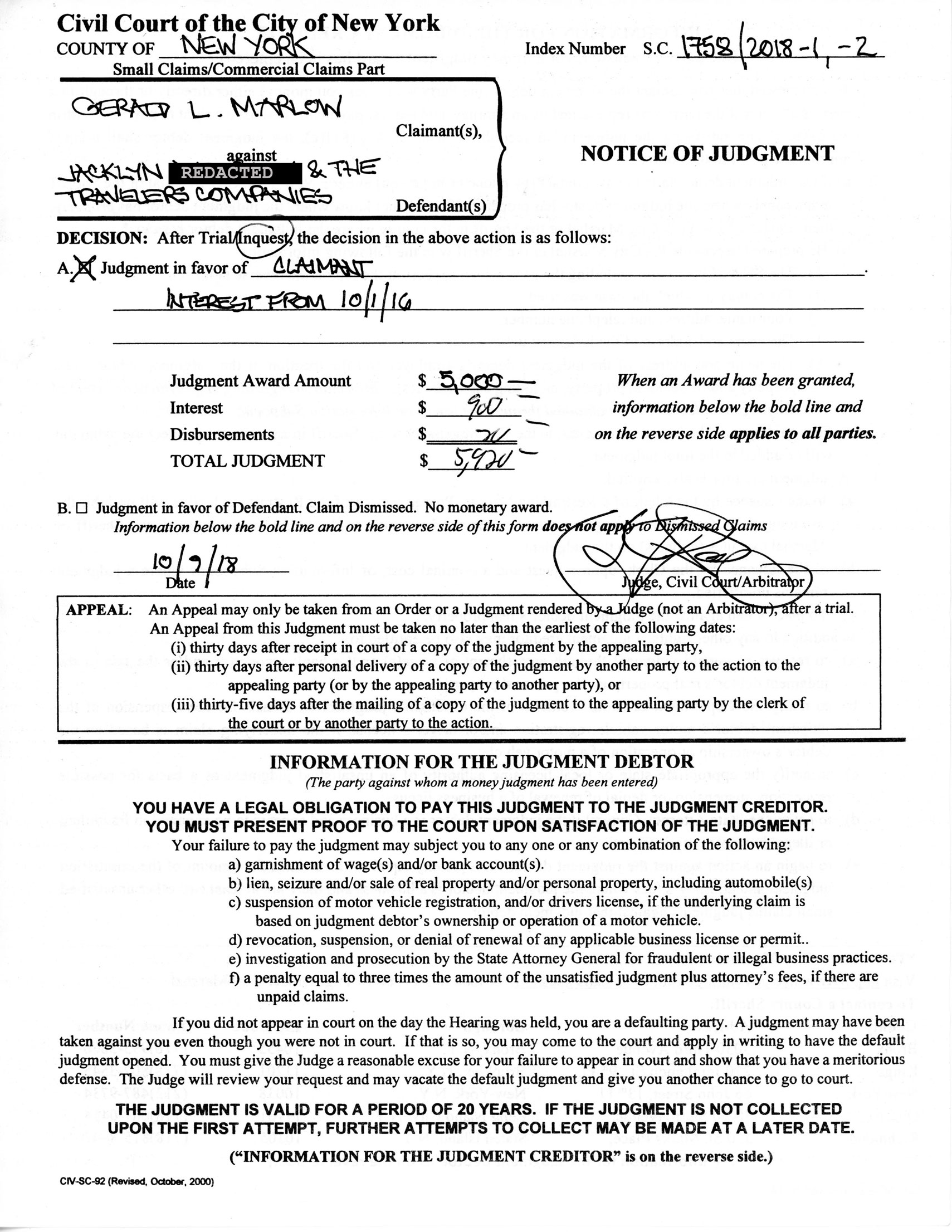
The arbitrator awarded me a judgement
against Travelers for $5,920.
That was the Small Claims Court’s
then maximum award of $5,000,
plus $900 interest,
plus reimbursement at Travelers’s expense
of the $20 court fee that I paid to sue them.
A couple of weeks later,
I received an envelope from Travelers.
I opened it.
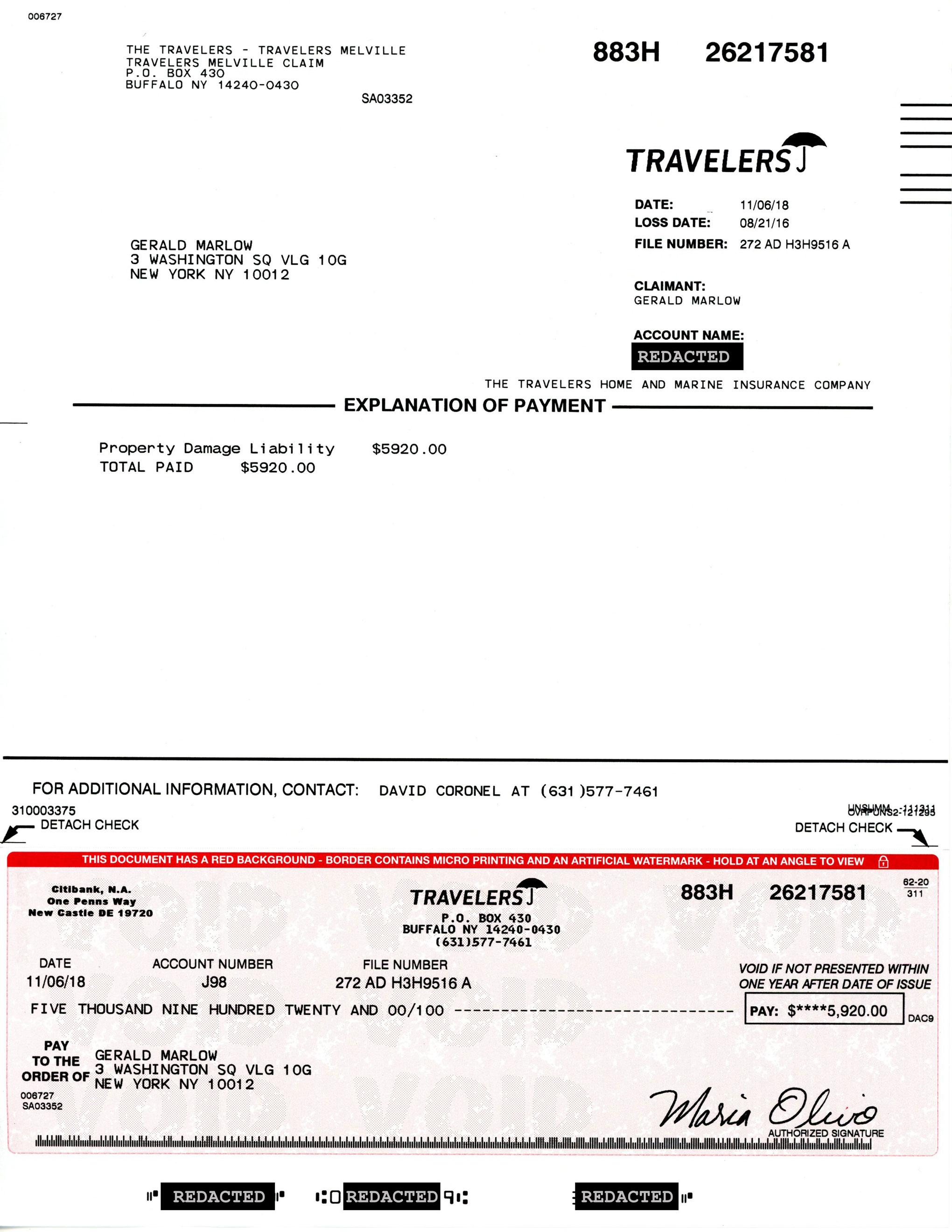
The $5,920 was on top
of the initial settlement check
that Travelers sent to me for $1,805.
In sum, after I exercised the rights
that New York State law gave me
and then sued Travelers
in Small Claims Court,
I got a total of $7,725.
That’s $6,081 more
than the $1,644
at which Travelers and CCC
initially and bogusly valued
my total‑loss vehicle.
That’s more than four times
the amount of money
that Travelers initially offered me.
That’s almost $8,000 cash money
for a total‑loss vehicle
that Travelers
and CCC Information Services
a.k.a. CCC Intelligent Solutions
initially valued at well less than $2,000.
In the end, CCC’s misconduct
and Travelers’s arrogance and defiance
worked in my favor:
I got a lot more money
than I would have gotten
had they offered me a fair valuation
in the beginning.
Why didn’t Travelers show up in court?
I dunno.
Maybe they knew they were going to lose?
Maybe their standard operating procedure
is to try to screw all claimants
and then, whenever those efforts fail,
skip the court appearance?
Maybe Travelers regarded the then
small-claims maximum award
of $5,000
as chump change
and not worth their bother?
Beats me.
What’s your guess?
What_I_didChapter
What I would do today
to get a fair valuation
of my total-loss vehicle
improves upon
what Maria and I did
to get fair valuations
of our total-loss vehicles.
What I would do today
to get a fair valuation
of my total-loss vehicle
is a further evolution
of what Maria did
and of what I did
to get thousands of more dollars
for our total-loss vehicles.
The steps that I would take today
would incorporate
what I have learned
and what I have figured out
since I began developing
wasyourcartotaledorstolen.com.
Soon I will tell you
what I would do today
to get a fair valuation
of my total-loss vehicle.
I will tell you
what I would do today
if I had not yet settled
my total-loss claim.
I will tell you
what I would do today
if I had already settled
my total-loss claim
and I had a right of recourse
and my right of recourse
had not yet expired.
I will tell you
what I would do today
if the automobile insurance company
sent me a check for my total-loss vehicle
a year or more ago
but I never agreed in writing
to their valuation amount
and the statute of limitations
had not yet expired on my right to sue
the automobile insurance company
for the money
that they cheated me out of.
But first, let’s talk about your rights.
Let’s talk about the rights
that you have in the settlement
of a first-party total-loss claim.
Let’s talk about the rights
that you have in the settlement
of a third-party total-loss claim.
Let’s talk
about how and why
those rights are different.
The more you know about your rights,
the more confidently and adeptly
you will be able to navigate
the settlement of your total-loss claim.
Up_next_know_your_rightsChapter
Nota bene
Jerry Marlow is not an attorney. Neither information nor opinions published on this site constitute legal advice. This site is not a lawyer referral service. No attorney‑client or confidential relationship is or will be formed by use of this site. Any attorney listings on this site are paid attorney advertising. In some states, the information on this website may be considered a lawyer referral service.
Terms of use
Jerry Marlow grants human users of wasyourcartotaledorstolen.com permission to use the copyrighted materials on wasyourcartotaledorstolen.com for their personal use free of charge.
The fee to use copyrighted materials on wasyourcartotaledorstolen.com to train artificial intelligence software (AI) is $4 million.
Reproduction of copyrighted materials on wasyourcartotaledorstolen.com for commercial use without the written permission of Jerry Marlow is strictly prohibited.
Jerry Marlow does not grant users permission to reproduce on other websites any of the copyrighted material published on wasyourcartotaledorstolen.com.
Jerry Marlow does not grant users permission to reproduce via audio, video, or any other audiovisual medium any of the copyrighted material published on wasyourcartotaledorstolen.com.
If you wish to use any of the copyrighted material published on wasyourcartotaledorstolen.com in any way for which permission is not explicitly granted, contact Jerry Marlow at jerrymarlow@jerrymarlow.com.